Wednesday, 11 September 2013

Banqueting Stuffe To Go


I have just finished making a table full of early modern period sweetmeats for a BBC production which will chart the arrival of Renaissance culture in England. It will all be dispatched in some carefully packed pizza boxes I have scrounged from the local take away. The photo above shows an assemblage of 'banqueting stuffe' typical of the late sixteenth and seventeenth century. On the large charger on the left are 'cinnamon letters according to arte', jumbals, printed bisket, Shropshire cakes, Naples bisket, artificial walnuts, rolled wafers and date leach. At the back two edible sugar tazze are covered with marchpane in collops, muscadines, white gingerbread, sugar plate playing cards and comfits. To the right of the white hart marchpane is a gilded and painted sugar plate trencher copied from one made of beechwood in the British Museum collection. The white gingerbread figures were printed from an original early Stuart mould in my collection and made from a recipe in Lady Anne Clifford's receipt book in the BL. 

White gingerbread figures
There are two edible sugar tazze. One is in Venetian style, the other inspired by the wonderful designs for salts and tazze supported by dolphins by Giulio Romano in the Fitzwilliam Museum. I am truly fortunate in owning a remarkable wooden mould designed to make a tazza of this kind. Next month, I am running a course on sugarwork and confectionery (full up I am afraid) and my students will get a chance to have a go at making one of these themselves.
Sugar tazza in the style of Giulio Romano - moulds below


Friday, 6 September 2013

Toad-in-a-Hole Biscuits and Friends

Some English biscuits from a recipe book published in the year of the French Revolution. Left: Toad in a Hole Biscuits, Top: Judge's Biscuits, Right: Fine Almond Faggots, Bottom: Yarmouth Biscuits
Biscuits have been on my mind for some time. Last week food writer and television cook Nigel Slater came to my kitchen to find out about how biscuits were made in Britain before they were mass-produced in factories. Nigel is the presenter of a programme on biscuits which will air on the BBC later this year. We made seventeenth century Shrewsbury Cakes from a recipe collected by John Evelyn and I introduced him to a number of forgotten English biscuits that once graced the dessert tables of the Georgian nobility. Most of these I made from recipes in Frederick Nutt's The Complete Confectioner (London: 1789). These luxury items, designed for accompanying wine rather than tea, are so much nicer than a lot of the manufactured biscuits consumed in Britain today They are also very easy to make. So I have appended some of Nutt's recipes at the end of this article. 

My all time favourites are his toad-in-a-hole biscuits, whose name almost certainly arose because of their similarity to the popular Georgian supper dish toad-in-a-hole. This cheap and cheerful delicacy was originally made by covering pieces of meat, usually beef, in a milk, egg and flour batter and baking it in the oven. The earliest printed recipe for the savoury toad-in-a-hole is in Richard Briggs, The English Art of Cookery (London: 1788) published only a year before Nutt's biscuit version. In the modern incarnation of the dish, the beef has been replaced with sausages. India Mandelkern, to my mind the foremost blogger on eighteenth century English food culture, has written a short, but fascinating essay on toad-in-hole, to which there is a link at the end of this posting.  

Toad-in-a-hole-biscuits were made from little rounds of almond paste into which one or two dried cherries were pushed before they were baked. Like the Yorkshire pudding batter used in the savoury dish, the almond paste rises as it bakes, enveloping the cherries, thus creating the miniature 'toad-in-a-holes'. Nutt's recipe calls for 'dried cherries'. What he means by this are syrup sweetened and candied cherries, not exactly the same as glacé cherries. I use dried morello cherries which work really well.

If my own favourite from the filming session was the toad-in-a-hole biscuit. Nigel Slater's was Nutt's 'Orange Biscuit', which he said was the most delicious biscuit he had eaten in his life. Tasting like a cumulus cloud lightly spread with marmalade, this fluffy, but incredibly crisp morsel dissolves on the tongue in micro-seconds. If you cannot read Mr Nutt's recipe in the photo below, I have appended a clearer version at the end of the posting.
Frederick Nutt's Orange Biscuits. Photo: Nigel Slater
One biscuit which originated in the early nineteenth century and remained popular for over a century was the Union Biscuit, designed originally to commemorate the Acts of Union of 1801. But why celebrate a political act with a biscuit? I cannot be sure, but I suspect that these biscuits were consumed with wine during the toasts at the end of a formal dinner. Toasts to the reigning monarch, Union etc. took place during the dessert course when biscuits were usually laid out with the other sweetmeats. These little biscuits pirnted with the word Union would have been perfect for nibbling with the sweet wines. They were still fashionable in the early twentieth century when Frederick Vine gave detailed instructions for making them in the second edition of his marvellous trade manual Biscuits for Bakers (London: 1906).

Union, Wine and some other patriotic friends
Vine not only explains the recipe, which is a very basic one, but the process of stamping them with the Union design. His full instructions are below. By 'volatile' he means ammonium bicarbonate, once known as sal volatile, or hartshorn, because it was formerly made by calcining stag antlers. At some point I will publish a detailed posting about volatile and other leavening agents.


Over many decades I have sought out quite a few of the biscuit prints and dockers formerly used by confectioners and bakers, but so far a Union Biscuit stamp has eluded me. However, I do own a remarkable biscuit roller which is carved with a total of fifteen different designs, among which is a Union stamp. Some of the other stamps on the roller are also patriotic. One, emblazoned with VR, dates the roller very definitely to the reign of Queen Victoria. There is also a royal crown, a shamrock of Ireland, a thistle of Scotland and a rose of England. Some of the other designs are decorative and represent ears of wheat, pineapples and a ship's anchor. One is engraved with the word WINE, indicating that it was for making a dessert biscuit to be consumed with a glass of wine.  


Frederick Vine gives five recipes for wine biscuits and has this to say on the subject,

'Almost all biscuits not made for special purposes are really wine biscuits; yet in almost every shop you will invariably find a special biscuit made and sold under this heading. Why it should be so, I know not; yet , being so it becomes my duty to direct your attention to the fact, and give a few special mixtures accordingly.'

What he is saying is that most biscuits were once made for consuming with wine. We now of course devour them more commonly with tea. Applying this information to the biscuits that my roller was used to produce makes a great deal of sense. Only one recipe mix was required to make the fifteen different biscuit designs, which I suspect were all intended to be used when toasting. The VR, the royal crown, the Union and the symbols of the constituent countries of the kingdom are all represented. During the nineteenth century the very large industrial biscuit manufacturers, such as Carrs, Huntley and Palmers, Peak Freans etc. produced many different stamped biscuits of this kind. Some like 'zoological biscuits' were moulded in the form of various animals for the delight no doubt of Victorian children, but all were made with the same basic recipe, usually along the lines of Vine's recipe for Union biscuits above. These enormous factories used mechanical rollers to produce their printed biscuits which were made by the million. Despite the competition from these big companies, small scale confectioners and bakers continued to make handcrafted biscuits using the old fashioned techniques described by Vine. However the biscuit roller was a step up from the biscuit stamp and I have had a great deal of fun using it to recreate these Victorian delights.

Twelve of the designs on the roller stamped into some biscuit paste. Note the symbolic flowers of Ireland, England and Scotland above. The pineapple  was a symbol much used for a confectioner's shop. The anchor represents the navy. The borders designs of the biscuits represent wheat straw and ears of corn. Although these biscuits can be trimmed down to size with a knife, I think it likely that originally a little rectangular tin cutter would have been used to cut them out more quickly.
Here are the recipes for the biscuits illustrated at the beginning of the posting. All are from Frederick Nutt, The Complete Confectioner (London: 1789). I suspect that some of them, like the fine almond faggots and orange biscuits, are Italian in origin. It is possible that Nutt learnt these from his master Domenico Negri, a confectioner from Turin who founded the Pot and Pineapple in Berkeley Square in the late 1750s. Because of the high sugar content, the orange biscuits blister and spread in the oven, but do not worry. When they are cool, just break off the ragged pieces round the edges and they will look good. The Yarmouth Biscuits are incredibly buttery. Delicious!


Toad-in-a-Hole Biscuits.

TAKE one pound of sweet, and one ounce and a half of bitter almonds, and pound them in a mortar very fine with water, then one pound and a quarter of Lisbon sugar, and mix it very well with the almonds: do not make it too thin, and remember there are no eggs in this; then put one sheet of paper on your wire, and some wafer paper on that, then take a spoon and make your biscuits round on the wafer paper, about the size of a half-crown piece; then put one or two dried cherries in the middle of them; and sift some powdered sugar over them, and put them in the oven, which must have a moderate heat, and when they come out, cut the wafer paper round them, but leave the paper at the bottom of them.

Judges Biscuits. 

TAKE six eggs and break them into a copper pan, yolks and whites together, whisk them well for about five minutes, mix half a pound of powdered sugar with the eggs, and whisk them for ten minutes, put as many carraway seeds as you think proper, and half a pound of sifted flour, mix it well with a wooden spoon, and put three papers on your plates ; then take a spoon and drop them on papers about the size of a crown piece, sift some powdered sugar over them, let them be rather thick in the middle, and the oven rather sharp and when they come out, cut them off the paper while hot.

Fine Almond Faggots.

CUT some sweet almonds in halves, put them and some whites of eggs in a bason together ; put a little powdered sugar, to make the almonds stick together, mix them well together in a bason ; put some wafer papers on your wire, make the almonds up in little heaps with your fingers, as big as you please ; sift a little powdered sugar over them, before you put them in the oven ; let them be a little brown, and then take them out, and cut the wafer paper off round them, that is ragged, and leave the wafer paper at the bottom of them.

Yarmouth Biscuits.

TAKE six ounces of currants, wash and pick them very clean, dry them well, rub a little flour among them to make them white, and put half a pound of powdered sugar with the currants upon a clean dresser, add twelve ounces of flour sifted, and half a pound of the best fresh butter you can get; break three eggs and mix all the ingredients together to become a paste that you can roll it on the dresser the thickness of an eighth part of an inch, and then cut them out either round or what shape you fancy.

N. B. Your oven must be rather hot, and put two or three sheets of paper under them, do not bake them too much, only just make them brown.

Orange Biscuits.

TAKE one pound of sweet almonds, pound them in a mortar very fine with whites of eggs ; take ten China oranges, rasp the rind off them very fine, and put it with the almonds ; add three pounds of powdered sugar, and mix. it well, if you find it too thick, put more whites of eggs to it and mix it well; then put two or three sheets of paper under, besides that you have put them on : let your oven have a moderate heat ; drop little round pieces of paste on your paper, about half as big as a nutmeg, and put them in the oven : let them have a fine brown, and take them off when cold.

N. B. Your oven must be rather hot, and put two or three sheets of paper under them, do not bake them too much, only just make them brown.

Please read India Mandelkern's great essay The Secret History of Toad-in-a-Hole

Wednesday, 21 August 2013

A Swan Supper on the Thames

A swan pie I made for the exhibition 'London Eats Out' held at the Museum of London in 2000.
I have just listened to a BBC radio news item about the remains of a mute swan discovered a few days ago on Baths Island in the Thames not far from Windsor Castle. The state of the bird indicated that it had been killed, skinned and then grilled on a disposable barbecue. Thames police have indicated that since swans are the property of the Crown, the case would be treated as one of theft. Mute swans also also have statutory protection under the Wildlife and Countryside Act and a Llandudno man was jailed for two months in 2006 for killing and eating a swan. Very few of us nowadays have had the dubious pleasure of dining on this regal bird, but I am pretty sure that the heartless hooligans who killed the Baths Island swan would not have enjoyed their illegal alfresco meal. In a newspaper photograph the charred left-overs of their supper appeared to belong to an adult specimen. Mature swans have little subcutaneous fat and their flesh is exceedingly dry, making them a tough and entirely unsuitable subject for barbecuing. It would have tasted awful. Serves them right I say. But we all know that swans were once eaten with relish by the wealthy at great feasts, one of the reasons why they were so valued by the Crown. But if they are such poor eating what was the fuss all about? Well swan once really was an esteemed dish, but it was not the adult birds that ended up in the pot (or on the grill for that matter). This is what Ross Murray, a compiler of household manuals for Victorian housewives told his readers in the 1870s,

'Roast Swan. This splendid dish, worthy of a prince's table, is only too locally known. It is, of course, only eligible for the table in its cygnet state.'

So it looks like they ate the babies - the ugly ducklings that is? Not exactly. Murray goes on to say, 

'The cygnets when all hatched are of a slaty grey, which grows lighter as they grow older. The cygnets of the wild swan are white. But it is of the grey cygnets we have to speak. They are hatched in June. If if is intended to eat them they must be taken from their parents and put into a separate swan pond, at the end of August or first week in September. After they have been "hopped or upped", as it is called, from their native place grass is thrown to them twice a day with their other food for a fortnight. They are fattened on barley: a coomb each cygnet suffices for the fattening. The corn is set in shallow tubs just under water. Cygnets can only be fattened before the white feathers appear; after that no feeding will do any good; as soon as a white feather shows they will cease fattening, no matter what food they have. They can consequently only be eaten in December, and they are a capital and magnificent Christmas dish. Their weight then will be from 25 lbs to 28 lbs.'*

So these teenage super-sizers were fattened by feeding each of them on a coomb of barley. A coomb was a dry measure consisting of four bushels! That was some fattening up process. They were slaughtered the moment their white adult plumage appeared, which pretty well coincided with Christmas. They were seven months old and pathologically obese. Murray goes on to tell us that swan was a popular local dish in Norfolk and explains how they were roasted in homes in that county on a spit in front of the fire as a Christmas dish. He explains that the finished swan was garnished with four little swans carved out of turnips and 'a paper frill, nicely cut, about the shoulders'. He even quotes a popular Norfolk poem on how to prepare the bird and provides a chromolithograph of the finished roast garnished with its miniature turnip swans and surrounded by all the other dishes of a high Victorian Christmas dinner. Both poem and illustration are reproduced below. 


So if ordinary Norfolk folk, other than the ones who resided at Sandringham, ate swan at Christmas were they breaking the law of the land like the heartless vandals who cruelly killed the Baths Island bird the other day? No. Because the swans they roasted on their spits were not necessarily the property of the monarch. All swans that were at liberty on open waters belonged to the Crown by prerogative right, but as long as the birds had their wings 'pinioned' and their bills marked, ownership could be granted to a landowner. Today the queen only claims her right to those birds on certain parts of the Thames that have not been marked by others. In addition to the monarch, there are not many other Thames swan owners, currently only two London livery companies - the Vintners and Dyers, who both have ancient rights to possess swans on the river. For centuries swans' bills were cut with identifying marks that indicated the identity of the 'swannery' to which they belonged. All over the country abbots, bishops and wealthy landowners raised young swans for their tables and all marked their bird's bills with unique distinguishing marks. These swan marks were granted by the Crown to the various owners. It was a similar process to that of being issued a Crown licence to have permission to develop a deer park on your estate. Between 1450 and 1600, there were about 630 swan marks recorded for different owners of swans on London waters alone. So the monarchy did not claim them all. The marks illustrated below were granted to various owners resident in Lincolnshire. Since these eccentric hieroglyphic barcodes were cut into the birds' bills, the practice was considered to be cruel to by Queen Alexandra and it was discontinued in the early twentieth century.

 Royal Society MS 106 pp 6-7.  A register of swan bill marks compiled by Elizabeth I's swan master. The various owners are identified to the left of the diagrams. Courtesy of the Royal Society.
A sixteenth century book of swan bill marks. Harley MS. 3405 ff. 18v-19. Courtesy of British Library
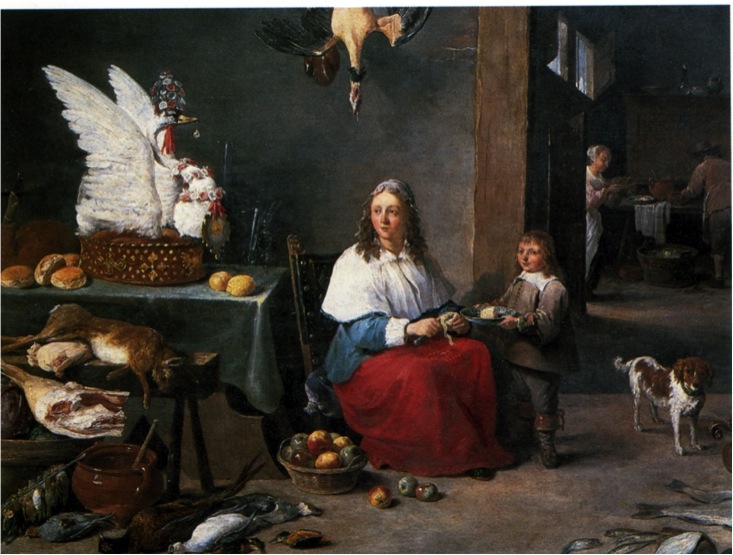
So swans were not only kept for looking pretty on your lake or moat, but had a definite gustatory purpose. As early as the thirteenth century they were an item of commerce and were being sold in markets as food. They were not cheap. In the reign of Edward III, they were sold at a price of four to five shillings, making them ten times more expensive than goose. In fact swans were eaten all over Europe and are frequently depicted in table still life paintings, usually sitting on top of magnificent pies. In 2000 I recreated a 1566 livery company feast in which swan pies featured for an exhibition at the Museum of London. I used a painting by David Teniers the Younger (reproduced below) as a model for the pies which had gilded pastry decorations, as well as taxidermy specimens of swans 'swimming' on their lids. 
A recreated 1566 livery company feast at the Museum of London
David Teniers the Younger, Kitchen Scene with Swan Pie. 1644 The Mauritshaus, The Hague.
Jan Breughel the Elder, An Allegory of Taste (detail). 1618. The Prado, Madrid
In England, of course swan featured on Christmas menus. Below is the bill of fare for a Christmas day feast published by the seventeenth century master cook Robert May. In the first course item 11 is 'A swan roast'. The second course is regaled with item 6 'A Swan Pye'.

From Robert May, The Accomplisht Cook. (London: 1660)
Nearly a hundred years after May published the bill of fare above, another Christmas dinner featuring a swan pie, this time as a centrepiece for the first course appeared in John Thacker's The Art of Cookery (Newcastle upon Tyne: 1758). Thacker was the cook to the Dean and Chapter at Durham Cathedral where there had been a swannery since well before the Reformation. He gives us a recipe which indicates that the Dean's Christmas Swan Pie would have been ornamented in the style of those depicted in the paintings above.

Bill of fare and recipe from John Thacker, The Art of Cookery (Newcastle upon Tyne: 1758)
By the nineteenth century, swan had gone out of fashion (other than in the wilds of Norfolk). However, the use of taxidermy swans to embellish fancy food items continued, as witness this bizarre trophy of woodcocks, snipe and other game birds illustrated by Theodore Garrett in the 1890s.

From Theodore Garrett, The Encyclopaedia of Practical Cookery (London: 1890s)

Although barley-fattened roast swan and swan pie had vanished, swans made of butter, ice cream, aspic, nougat, chocolate and countless other confections graced the entremet courses of the Victorian high class dinner party. Mould manufacturers had a field day producing swans in copper, tin, pewter and wood for kitchen staff to make these decorative sweet substitutes.

Ice cream and sorbet swans were very popular on the high Victorian table
An ice cream swan did not require a licence from the crown 
One half of a butter print in the form of a swan
I found this cutting in a Victorian scrapbook. I do not know its original French source. It explains how the English performed a trick at the table by concealing a small piece of iron in a butter swan and then with a magnet hidden in a piece of bread, encouraged the swan to swim across a wet plate!
So with a magnet discreetly sealed in a piece of bread I had a go. It worked! 

*Ross Murray, The Modern Householder, A Manual of Domestic Economy. (London: nd. 1870s) pp. 338-9.

Visit the Queen's official webpage on swans and the custom of 'swan upping' on the Thames
This webpage has an excellent video narrated by David Barber, the Queen's Swan Marker

Tuesday, 20 August 2013

Of Lumbard Pies, Green Puddings and Pennyroyal Dumplings


Pennyroyal (Mentha pulegium L.) has been used as a culinary and medicinal herb since antiquity. One of its popular English synonyms 'Pudding Grass' clearly indicates that this mint-like herb was a popular ingredient in certain kinds of puddings. It is still used in some regional versions of black pudding, such as those made in Bury in Lancashire. However, the popularity of pennyroyal as a kitchen herb waned during the course of the nineteenth century and nowadays it is rarely used in a domestic context. This is almost certainly due to two rather worrying factors. The first of these was the traditional folk belief that the plant could be used to induce abortions and should therefore be avoided at all costs by pregnant women. The second was the more recent discovery that the essential oil of pennyroyal is highly toxic and its consumption has frequently proved fatal to both humans and animals - and probably to insects too, as over the centuries the plant was widely used to discourage fleas, lice and other six legged pests. It should not come as a surprise then that nowadays it is not to be found on the supermarket herb and spice shelf. However, the dried herb can be obtained from herb suppliers and some still make a tisane from it, the consumption of which in moderate quantities is considered to be pretty harmless, as is its inclusion in small quantities in black puddings.

Pennyroyal was also once employed as a flavouring for other members of the pudding family, including an unusual herb dumpling, a recipe for which was included in Charlotte Mason's The Lady's Assistant (London: 1773). 

Like many other puddings, Mrs Mason's  pennyroyal dumplings were boiled in cloths. 
Mrs Mason's pennyroyal dumpling is closely related to another commonly made pudding called 'green pudding'. Some think that this was consumed as a spring tonic, rather like the herb pancake known as a tansy. Green puddings were certainly designed to be eaten during Lent and at Easter. Pennyroyal is frequently an ingredient, though it is often just one of a medley of different garden and wild herbs. The late seventeenth century recipe below also includes spinage, savory and thyme.

This recipe for green puddings is from the unpublished Receipt Book of Elizabeth Rainbow (d. 1702). It instructs us to 'boil' (fry) the little puddings in butter in a dish, rather than boiling them in a cloth. Elizabeth was the wife of Edward Rainbow (1608-84 ), the bishop of Carlisle. Photo © Dalemain Estates.
Although Elizabeth Rainbow's recipe called for the green puddings to be fried, they were more usually boiled in a cloth, like Mason's pennyroyal dumplings. However, the recipe below from the manuscript receipt book of Elizabeth Birkett (aka Brown) dated 1699, specifically instructs us to boil her pudding in a bag, rather than a cloth. Her recipe does not include pennyroyal and is flavoured with strawberry leaves, violet leaves, thyme and marjoram. Like Mason's and Rainbow's dishes, the basis of the pudding is grated bread. 

A green pudding recipe from the manuscript receipt book of Elizabeth Birkett (1699) of Townend Farm, Troutbeck, Cumbria. Photo courtesy of Kendal Public Record Office.
Elizabeth Birkett's' Greene Pudding' 1699. This pudding was wrapped in a caul before being boiled in a bag
Both Elizabeth Rainbow and Elizabeth Birkett wrote their recipe collections in the late seventeenth century in the English Lake District, a part of the world where green or herb puddings are still made today, most usually at Easter. To some Cumbrian locals these latter day paschal puddings are known as 'Easter Ledge Pudding', 'Easter Ledges' or 'Easter May Giants'. These curious terms are also local vernacular names for bistort (Persicaria bistorta (L.) Samp.), one of the main ingredients of the dish. Incidentally another regional name for bistort is 'pudding grass'. Other herbs included in the mix are alpine lady's mantle, nettle leaves, giant bellflowers and black currant leaves. However, I have not yet come across a modern Lakeland recipe which calls for pennyroyal. Both Rainbow, a bishop's wife and Birkett, the wife of a yeoman farmer, used wheaten bread as a basis for their herb puddings. But in their day only the well-off could afford white bread, because wheat was very difficult to cultivate in the wet, cool climate of the Lake District. Oats and barley were the staple cereals for the poorer farmers. The surviving modern Cumbrian recipes for herb pudding are made with a base of either oatmeal or pearl barley, so it is likely that they have evolved from a more low status version of the dish, rather than the somewhat genteel puddings described by the two Elizabeths. This may well also explain why modern versions of Easter Ledges Pudding are made from foraged wild plants, which are free, rather than the Mediterranean herbs that were grown in the gentlewoman's herb garden. As green puddings became unfashionable among the increasingly more sophisticated gentry of the eighteenth and nineteenth centuries, the conservative Lake District peasantry continued to make their version of the dish, which has survived to this day among the farming community. Though of course there seem to be no surviving printed recipes for their dish earlier than the twentieth century. 

Easter Ledges or Easter May Giants, two of a number of Cumberland/Westmorland dialect names for bistort (Persicaria bistorta (L.) Samp.). The leaves of this plant, which like pennyroyal is sometimes called 'pudding grass', are picked when young and tender.
A friend and neighbour of mine, who gathers her Easter Ledges from the same stream-side in our village as I do, recently showed me two precious family heirlooms - the pudding bags used by her mother and grandmother in which they boiled the Easter herb pudding mix. These venerable 'clouts' are made from 'ticking', a strong weave of textile used for making mattresses and pillows. They are stained with the juice of generations of herbs. Both bear a few campaign scars which have been neatly repaired. I suspect that the 'bag' mentioned in Elizabeth Birkett's greene pudding recipe must have looked just like these hoary veterans.
Two well-used veteran Westmorland herb pudding bags. Photo courtesy of  Jean Scott-Smith
So herb puddings could be fried in butter, or boiled in a cloth or bag. In Elizabeth Birkett's recipe for green pudding she tells us 'to wrap it in a mutton caul' before you boil it in a bag. The caul fat of calves and lambs was much used in the early modern period for holding fragile ingredients together in dishes of this kind. The caul or omentum, is the inner lining of the animal's abdomen and its anastomising network of veins of fat on a thin transparent membrane give it the appearance of very delicate lace. Not only does it work very well as a wrapping, but the fat also bastes the outside of the pudding. In some regions of England caul is still used for making a fatty jacket for wrapping the little pork offal 'puddings' known as faggots or savoury ducks.  


'Caule of veale, or lamb' turns up in another of Elizabeth Rainbow's recipes, this time in a pie filled with little round puddings flavoured with herbs, including pennyroyal. The recipe is acknowledged as one contributed to Elizabeth by a Lady Sedley. This was Catherine Sedley, daughter of John Savage, Earl of Rivers, who married Sir Charles Sedley the poet and courtier in 1657. A surviving book of receipts (mainly medical) dated 1686 by Lady Sedley survives in the library of the Royal College of Physicians. Lady Sedley's husband, a favourite companion of Charles II was noted for his drunken, often lewd behaviour. 

A lumbard pye, sometimes known as a lumber pie, was a pie filled with meat balls, or as in this rare example, miniature green puddings. In fact, the small caul wrapped puddings in Lady Sedley's Lumbard Pye are very similar to Charlotte Mason's pennyroyal dumplings cited earlier in this post. Both have pennyroyal as a principal flavouring and both contain currants. However, Lady Sedley's little pennyroyal dumplings are wrapped in caul and baked in a pie with butter, marrow and dates. The pie is later filled with a 'caudle' made of wine, egg yolks and sugar. Unlike most of the lumber pie recipes from this period, the filling contains no meat. Lady Sedley's little pie-baked puddings are not a hundred miles away from the modern butcher's faggot in construction, if not in ingredients. Lumber pies however, were luxury dishes found only at the tables of the rich.  


Elizabeth Rainbow also gives a recipe for a more conventional Lumbard Pye, this time filled with 'round balles' made of minced lamb or 'the brawn of a cold Capon' (cooked chicken's breast). Unusually each ball contains a 'soft centre' in the form of an egg yolk and a 'good piece of marrow'. Each one is wrapped in an endive and/or? sorrel leaf before they are baked with a rich assortment of artichoke hearts, skirrets, potatoes, chestnuts, dates, hard egg yolks, marrow, barberries, grapes, preserved orange peel, apricots or other preserved fruit. Like Lady Sedley's, the pie is filled after baking with a caudle and put back in the oven to warm through. I will be making both of these lumbard pies over the next few weeks and will eventually post an article about the full process.


The author of the above recipe was Elizabeth Nodes (b.1648), who married Charles Fane, the 3rd Earl of Westmorland in 1665. She probably met Elizabeth Rainbow in London, most likely at Suffolk House, the London home of the Earls of Suffolk. Little is known about Lady Westmorland, but a fine portrait of her was painted by John Michael Wright.
Elizabeth, wife of Charles Fane, 3rd Earl of Westmorland, by John Michael Wright
Most of the printed cookery books and many manuscripts of the seventeenth and early eighteenth century give at least one recipe for lumber, lumbard or lombard pies. They seem to have been very popular. The name is usually assumed to be a corruption of Lombard, suggesting some Italian link, but its true origin remains obscure. The herald Randal Holme in An Anatomy of Armoury (Chester:1688) defines it thus,

'Lumber pie, made of Flesh or Fish minced and made in Balls‥with Eggs‥and so Baked in a Pye with Butter'.

Over the course of the past three decades I have made many different lumber pies. It is my favourite English pie of the early modern period. On my Pie and Pastry course I frequently teach my students to make one of Robert May's versions of the dish, usually from the recipe below, though over the years we have also made two of his fish based lumber pies - one of sturgeon and the other with salmon.

To Make a Lumber Pye
Take some grated bread, and beef-suet cut into bits like great dice, and some cloves and mace, then some veal or capon minced small with beef suet, sweet herbs, fair sugar, the yolks of six eggs boil’d hard and cut in quarters, put them to the other ingredients, with some barberries, some yolks of raw eggs, and a little cream, work up all together and put it in the caul of veal like little sausages; then bake them in a dish, and being half baked have a pie made and dried in the oven ; put these puddings into it with some butter, verjuyce sugar, some dates on them, large mace, grapes, or barberries, and marrow - being baked, serve it with a cut cover on it, and scrape sugar on it.


From Robert May, The Accomplisht Cook (London: 1660).

A lumber pie made on a recent pie and pastry course from Robert May's recipe above. Each meat ball has been wrapped in caul. The bright red berries are barberries.
May tells us to finish the pie with a cut lid scraped with sugar

Designs for the pastry cases for lumber pies abound in seventeenth and early eighteenth century cookery books. Many were quite elaborate and often had very eccentric shapes, as those reproduced below. 

Lumber pie designs from Robert May, The Accomplisht Cook (London: 1660)
A stumpe or lumber pye design from Hannah Bisaker's manuscipt receipt book (1690s). A stumpe pie was usually filled with a spiced mixture of mutton and currants. I am currently baking my way through Hannah's many lovely pie designs and will eventually post an article called 'Baking with Bisaker', my own personal antidote to The Great British Bake-off. However in the next few weeks I will make Lady Sedley's Lumbard Pye and bake it in Hannah's case and publish the results in another post on the subject of lumber pies. Photo courtesy Wellcome Library


Above: a rather crude lumber pie design from T.P., The Accomplish'd Lady's Delight (London: 1675). Below: Edward Kidder, in Receipts of Pastry and Cookery (London: nd. c.1720) offers this much more neatly delineated version of the same design.
However, one lumber pie design in particular seems to have been popular, as it is illustrated in at least three different sources. A 3D version of the design was even published on a playing card! This remarkable and rare pack of playing cards was illustrated with directions for carving various foods. It was issued in 1676/77 by the London printers Joseph and James Moxon. All of the cards belonging to the clubs illustrate the modus operandi for carving up pies and pasties. The six of clubs shows a lumber pie in the same form as the design published the previous year in The Accomplish'd Lady's Delight, but much more skilfully drawn and showing dissection marks used for cutting up the lid. Time after time, recipes for these early modern pies instruct us to cut up the lid. This card shows how it was actually undertaken with a lumber pie. This is by far the most detailed illustration of the form of a lumber pie and is the one I will be using when I make Lady Westmorland's version of the dish later this month - watch this space! 

The Moxon's six of clubs with its Lomber or Lumber Pie
The label on Moxon's pack of carving cards
I have posted this scan from my paper 'Illustrations in British Cookery Books', 1621-1820 in Eileen White (ed.), The English Cookery Book - Historical Essays. (Prospect Books, Totnes:2004) to illustrate a point I make in my reply to Kaprifolia's comment below.